Zhora Kryzhovnikov on Gaidai’s Comedies: Highlights of His Director’s Breakdown
In short
Gaidai is a unique director who, while outwardly belonging to Soviet comedy, created pure entertainment.

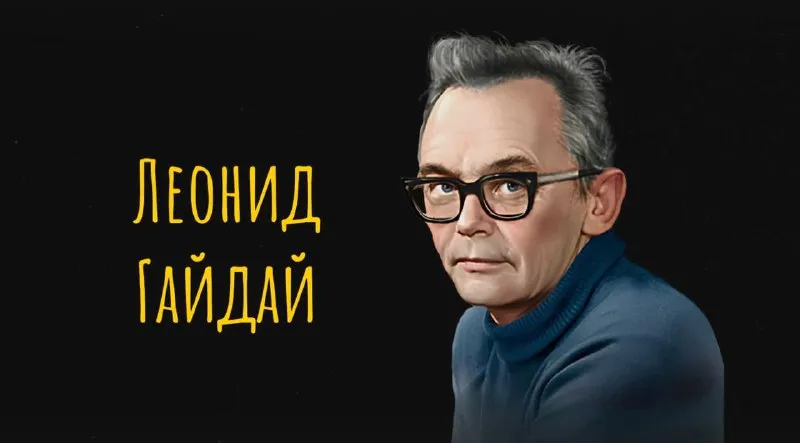
Zhora Kryzhovnikov has released a new director’s breakdown, this time of the work of Leonid Gaidai!
As last time, I have prepared a recap post with the main and most interesting points (and in brackets I have added bits of my own musings, relevant and otherwise)
-
The most American of Soviet directors, Gaidai was guided largely by stunts, attractions and entertainment rather than by exploration. To examine his style, analysing one film is not enough, so the breakdown covers Gaidai’s work as a whole.
-
The situation comedy Gaidai practised rests on holding the viewer (uderzhanie). It works through two other Russian “U”s: recognition (uznavanie) and surprise (udivlenie). But whereas for Ryazanov the plausibility of events mattered (hence, too, the inserts of semi-documentary street footage), Gaidai’s priorities are quite different. Most of the gags that work on surprise are completely fantastical: take, for instance, Gorbunkov’s trip to a capitalist country in The Diamond Arm. It does not correspond to reality, but it holds you thanks to the direction and the pacing.
-
The pleasure of the attractions is inherently greater than the need to ask questions about what is going on. Paradoxically, the fantastical gags in Gaidai’s films tell us about the characters and win our trust. Therein lies the phenomenon of this director, which has not been repeated to this day.
-
The concept of comedy as taught at school took shape in Stalin’s times. For details, see the book Kryzhovnikov recommends, State Laughter: Stalinism, Populism, and Origins of Soviet Culture («Госсмех. Сталинизм и комическое») (it joins my reading list). A Soviet person could only have the laughter of the victor, at swindlers and petty crooked officials. Soviet comedy always has a positive hero. Hence the stock perception of comedy as having an educational function. This is the reality Gaidai found himself in at the start of his career.
-
Gaidai is a unique director who, while outwardly belonging to Soviet comedy, created pure entertainment.
-
Gaidai’s first films, Zhenikh s togo sveta («Жених с того света», “The Groom from the Other World”) and Trizhdy voskresshiy («Трижды воскресший», “Thrice Resurrected”), were very hard ordeals for the director, which he disliked recalling for the rest of his life (and we have practically never heard of them).
-
Gaidai adored silent cinema. Kryzhovnikov is also of the opinion that a film should be understandable even with the sound off (an evening’s entertainment: I will rewatch Gorko! («Горько!», “Bitter!”, Kryzhovnikov’s 2013 wedding comedy) with this thought in mind).
-
Gaidai worked with a stopwatch: he timed the gap from one laugh moment to the next, which is exactly why, 60 years on, we still watch his films with interest.
-
The director gravitated towards the short form: this format grabs attention faster. His feature films often consist of several segments, and long films made him uncomfortable because of potential viewer fatigue.
-
Gaidai’s concept of situation comedy is safe entertainment. In his films there is no real pain, nobody dies and nobody walks out on anyone. The basic principle is “beautiful women + funny men”. Every element of Gaidai’s comic style is unique and based on his favourite films (for example, the references to Buster Keaton). Perhaps one day Russian cinema will produce someone to carry on Gaidai’s work.