Race to Monte Carlo: The Escapism of Silver Skates and the Drive of F1
In short
“Race to Monte Carlo” is a 2026 film directed by Ilya Malanin. Race to Monte Carlo has managed to recapture the unique escapist mood of Silver Skates and at the same time to outdo F1 in the drive of its racing scenes. And all this with an almost fairy-tale narrative, which here even works to its advantage.

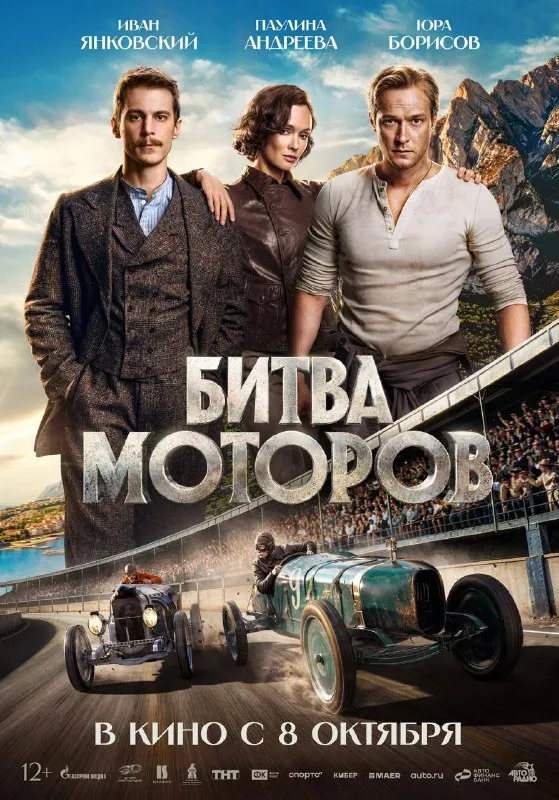
Race to Monte Carlo (Bitva motorov, “Battle of Motors”) has managed to recapture the unique escapist mood of Silver Skates and at the same time (to my mind) to outdo F1 in the drive of its racing scenes. And all this with an almost fairy-tale narrative (which here even works to its advantage).
The film about the development and fleeting triumph of the first car built in the Russian Empire has absorbed the best of the Russian and Hollywood traditions. It manages to cross the concept of the American dream with a road movie and an utterly sentimental view of a pre-revolutionary aesthetic that has sunk into oblivion. At the peak of its idealisation the film even lets you forget such basics as class divisions; here everything follows the example of Silver Skates. Impossible, but so good. Technically, Race to Monte Carlo also stands on very solid ground: the racing scenes are stunning, with a palpable nerve, and the costumes, sets and period cars catch the eye too. The team of supporting characters is written and played brilliantly.
What pulls you in, of course, is the dynamic between Ivan Yankovsky’s and Yura Borisov’s characters: they are the real engines of the picture. The wily, virtuosically brazen motoring enthusiast Andrey Nagel is the main character in the first part of the film, and he honestly balances somewhere between the uncompromising Bokov from Fisher and the many-faced Adidas from The Boy’s Word. Dmitry Bondarev, in whom an engineer’s passion gradually awakens, is even slightly more interesting to watch: he has contradictions, distrust of the world and an indomitable spirit. This duo is written really well and colourfully, even if it does not quite match the historical facts about Russo-Balt.
There is one weak spot: the central heroine, a motoring enthusiast played by Paulina Andreeva, fits into the inventors’ competitive friendship far too schematically. She appears and disappears like a strictly prescribed plot function and, sadly, never becomes a full-blooded figure (unlike, say, the heroine of Silver Skates). Another curious result (whether successful or not is for each viewer to decide) is Emperor Nicholas II: deliberately cute, there is no other word for it, he both supports the automotive inventors and shrugs off the chief antagonist’s denunciations. Unlike the wicked officials who very nearly wrecked Nagel’s entire car production.
All in all, it is worth seeing: this is big cinema, and it can quite rightly be called both an attraction and a sentimental reconstruction of a world lost forever; however you take it, it will impress you either way.
Off to think about the Roman Russian Empire